



The xG-ALOE User Forum 2026, organized by the Fraunhofer-Gesellschaft (Fraunhofer Institute for Telecommunications, Heinrich-Hertz-Institute HHI and Fraunhofer Institute for Integrated Circuits IIS), is a hands-on event dedicated to open 5G campus networks and enterprise connectivity.
The forum brings together users, system integrators, technology providers, and research institutions to exchange experiences, discuss real deployments, and explore future developments from 5G towards xG enterprise networks.
Participants can expect technical tutorials, real-world use cases, demonstrations, and networking opportunities across industry and research.
Date:
June 24–25, 2026
Location:
Fraunhofer IIS
Nordostpark 84
90411 Nuremberg
Germany
Registration:
Spaces are limited and participation is subject to a fee.

Organization & Sponsoring:
For inquiries regarding sponsorship opportunities, participation in the marketplace or demo area, or any general questions, please contact:

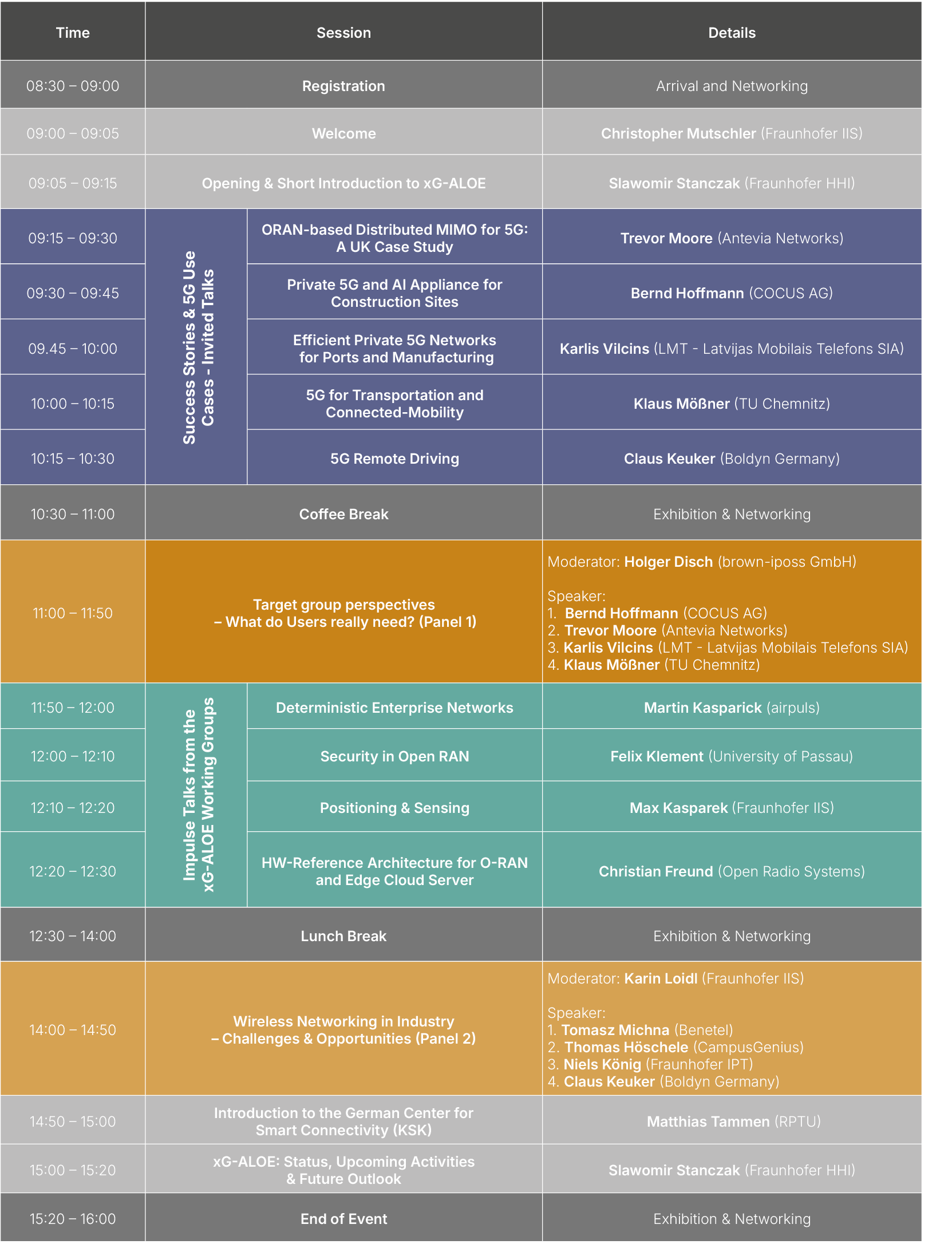
Please note that the program is currently still being finalized and updated. The program is subject to change.
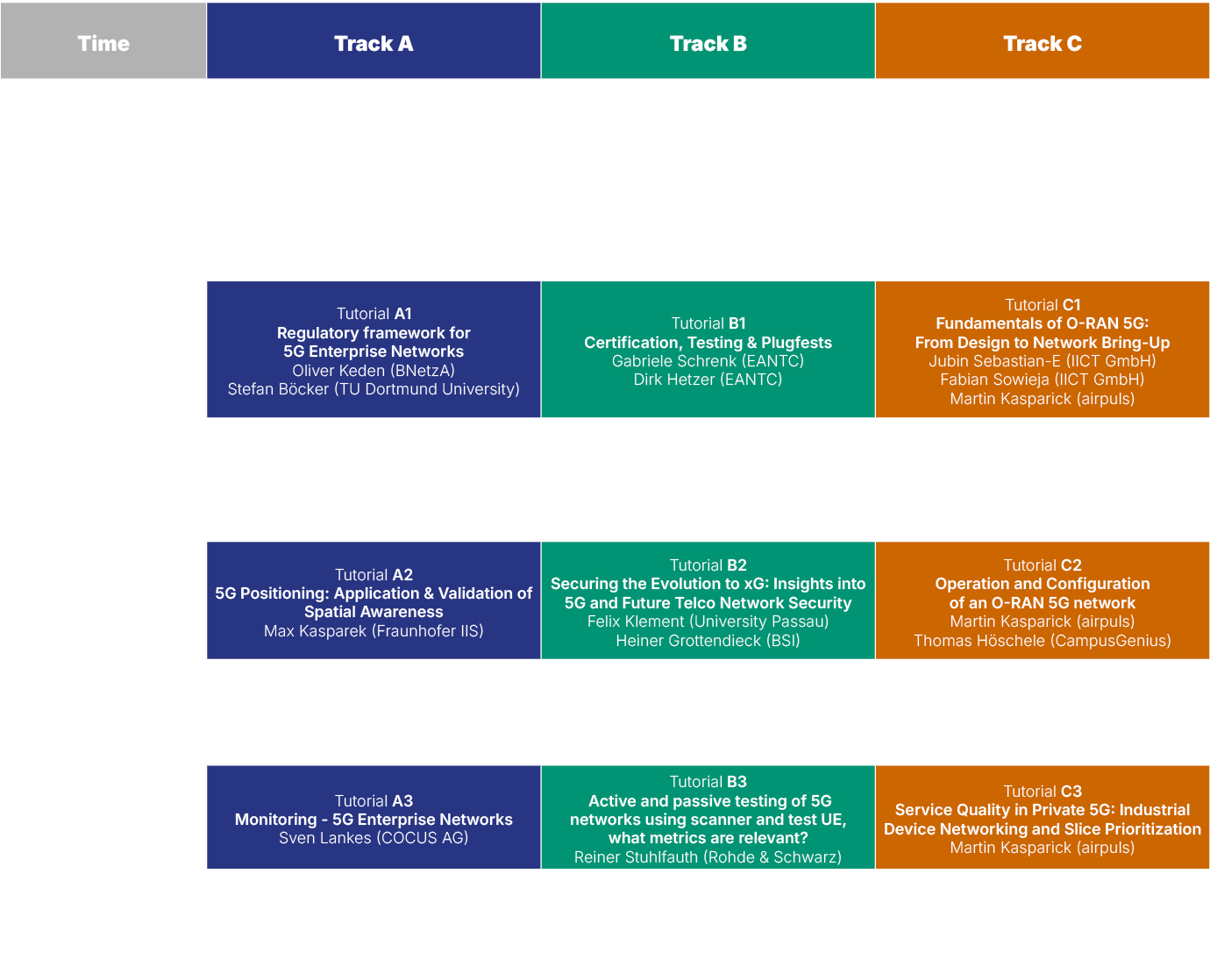
Learn more about your tutorials ↓
Info coming soon
Tutorial A2 provides a practical introduction to 5G positioning and spatial awareness technologies based on measured data and real world validation results. The session explores how network-based 5G positioning is implemented, which accuracy levels can realistically be achieved, and how positioning performance is benchmarked and evaluated in practice. In addition, the tutorial highlights how positioning and sensing technologies can support applications in safety, logistics, and industrial automation, while also addressing current technical limitations and open challenges. The tutorial is particularly suited for engineers and practitioners seeking a realistic understanding of the current state and practical deployment potential of 5G positioning technologies.
This tutorial focuses on the monitoring and operational visibility of 5G enterprise networks, using the COCUS Campus2Go MPN solution as a practical example. In a hands-on session, participants will see how network events and performance indicators can be collected, visualized and translated into actionable monitoring insights.
The tutorial will demonstrate how a Grafana, Prometheus and VictoriaAlerts-based monitoring stack can be used to supervise the availability and performance of a private 5G network. Special attention will be given to creating custom alarms for relevant operational events, such as network availability issues or throughput degradation, including monitoring down to the level of a specific UE devices traffic patterns.
A live demonstration will show how selected metrics can be observed, how alarms can be defined and triggered, and how these alerts can support troubleshooting and day-to-day network operations. The accompanying presentation will explain the most relevant monitoring concepts, key performance indicators and alerting strategies for private mobile networks. In addition, practical suggestions will be given on how monitoring data can be used to improve reliability, detect issues early and support efficient operation of 5G enterprise networks.
Tutorial B1 provides a comprehensive introduction to O-RAN systems and their testing and validation ecosystem. The session covers the fundamentals of O-RAN architectures, open interfaces, and the motivation behind testing in disaggregated network environments. Participants will gain insights into relevant interfaces, test objects, and typical sources of interoperability and performance issues. In addition, the tutorial explores key aspects of O-RAN testing and validation, including conformance, interoperability, end to end performance, and IoT related evaluations, as well as commonly used test methods and tools. Real world campus deployment use cases and relevant KPIs will be discussed alongside certification processes, automation approaches, and practical experiences from Plugfests and collaborative validation activities.
In this joint session, the German Federal Office for Information Security (BSI) and the University of Passau present current works and research on the protection of 5G and telecommunication networks. The session combines perspectives from national initiatives and academic work on the security challenges of modern, increasingly open and disaggregated telco architectures. Participants will gain an up-to-date overview of the 5G security landscape, a deeper understanding of emerging risks associated with network evolution, and practical insights into assessing and strengthening resilience on the path towards xG.
This tutorial touches on the mobile network testing aspect with focus on two common test tools that support proper spectrum clearance, site installation and network optimization. With a live demo, the operation of a mobile network scanner will be shown, what signals can be detected ,what information is relevant to ensure a 5G network is functional and operational? By adding a test UE it is possible to perform active tests and depending on the availability we like to execute such live tests and analyze metrics like radio link quality, data throughput and quality as well as latency topics. A presentation, accompanying the tutorial will explain the most relevant key performance parameters and metrics on how private mobile networks can be tested and evaluated. In addition, suggestions for network troubleshooting and optimization will be presented.
This introductory tutorial provides the fundamentals of enterprise 5G network architectures, including key concepts such as network planning, 5G wireless communications, O-RAN architectures, quality of service, and essential configuration parameters using IICT’s hands-on learning platform. Participants will learn how to bring up and configure a portable 5G network, explore most relevant interfaces, and understand real-world deployments through interactive exercises in the learning platform, practical demonstrations and use-case examples. This tutorial prepares participants for the subsequent, more advanced hands-on sessions.
This hands-on tutorial introduces the management and configuration of an O-RAN-based 5G network, from setup to performance monitoring. Participants will learn how to onboard new users by provisioning SIM cards and integrating 5G dongles, enabling secure device access to the network. The session then walks through establishing live end-to-end data traffic, including how to verify connectivity and continuously monitor key performance indicators. Finally, the tutorial highlights critical radio and system (re)configurations such as uplink/downlink (UL/DL) split, bandwidth selection, and center frequency adjustment, demonstrating their impact on network behavior and performance. By the end, attendees will understand the practical steps to operate an O-RAN 5G network and how to adapt its configuration to evolving user and application requirements.
This tutorial demonstrates how to use a private 5G network to deliver reliable service quality and robust device connectivity for industrial applications. Participants will walk through a representative industrial use case by integrating an industrial 5G router into the network and attaching end devices such as cameras via Ethernet or Wi-Fi. The session will cover router configuration steps (including NAT and related settings) to ensure that devices behind the router are reachable from the 5G network. In addition, the tutorial will illustrate the impact of network slicing by assigning higher priority to the industrial user equipment (UE) compared to other UEs, using performance tests to show the tangible effects on throughput and latency. Attendees will gain practical insight into operating private 5G setups that meet stringent industrial service quality requirements.


The xG-ALOE User Forum 2026, organized by the Fraunhofer-Gesellschaft (Fraunhofer Institute for Telecommunications, Heinrich-Hertz-Institute HHI and Fraunhofer Institute for Integrated Circuits IIS), is a hands-on event dedicated to open 5G campus networks and enterprise connectivity.
The forum brings together users, system integrators, technology providers, and research institutions to exchange experiences, discuss real deployments, and explore future developments from 5G towards xG enterprise networks.
Participants can expect technical tutorials, real-world use cases, demonstrations, and networking opportunities across industry and research.
Date:
June 24–25, 2026
Location:
Fraunhofer IIS
Nordostpark 84
90411 Nuremberg
Germany
Registration:
Spaces are limited and participation is subject to a fee.
Organization & Sponsoring:
For inquiries regarding sponsorship opportunities, participation in the marketplace or demo area, or any general questions, please contact:
Please note that the program is currently still being finalized and updated. The program is subject to change.
Learn more about your tutorials ↓
Info coming soon
Tutorial A2 provides a practical introduction to 5G positioning and spatial awareness technologies based on measured data and real world validation results. The session explores how network-based 5G positioning is implemented, which accuracy levels can realistically be achieved, and how positioning performance is benchmarked and evaluated in practice. In addition, the tutorial highlights how positioning and sensing technologies can support applications in safety, logistics, and industrial automation, while also addressing current technical limitations and open challenges. The tutorial is particularly suited for engineers and practitioners seeking a realistic understanding of the current state and practical deployment potential of 5G positioning technologies.
This tutorial focuses on the monitoring and operational visibility of 5G enterprise networks, using the COCUS Campus2Go MPN solution as a practical example. In a hands-on session, participants will see how network events and performance indicators can be collected, visualized and translated into actionable monitoring insights.
The tutorial will demonstrate how a Grafana, Prometheus and VictoriaAlerts-based monitoring stack can be used to supervise the availability and performance of a private 5G network. Special attention will be given to creating custom alarms for relevant operational events, such as network availability issues or throughput degradation, including monitoring down to the level of a specific UE devices traffic patterns.
A live demonstration will show how selected metrics can be observed, how alarms can be defined and triggered, and how these alerts can support troubleshooting and day-to-day network operations. The accompanying presentation will explain the most relevant monitoring concepts, key performance indicators and alerting strategies for private mobile networks. In addition, practical suggestions will be given on how monitoring data can be used to improve reliability, detect issues early and support efficient operation of 5G enterprise networks.
Tutorial B1 provides a comprehensive introduction to O-RAN systems and their testing and validation ecosystem. The session covers the fundamentals of O-RAN architectures, open interfaces, and the motivation behind testing in disaggregated network environments. Participants will gain insights into relevant interfaces, test objects, and typical sources of interoperability and performance issues. In addition, the tutorial explores key aspects of O-RAN testing and validation, including conformance, interoperability, end to end performance, and IoT related evaluations, as well as commonly used test methods and tools. Real world campus deployment use cases and relevant KPIs will be discussed alongside certification processes, automation approaches, and practical experiences from Plugfests and collaborative validation activities.
In this joint session, the German Federal Office for Information Security (BSI) and the University of Passau present current works and research on the protection of 5G and telecommunication networks. The session combines perspectives from national initiatives and academic work on the security challenges of modern, increasingly open and disaggregated telco architectures. Participants will gain an up-to-date overview of the 5G security landscape, a deeper understanding of emerging risks associated with network evolution, and practical insights into assessing and strengthening resilience on the path towards xG.
This tutorial touches on the mobile network testing aspect with focus on two common test tools that support proper spectrum clearance, site installation and network optimization. With a live demo, the operation of a mobile network scanner will be shown, what signals can be detected ,what information is relevant to ensure a 5G network is functional and operational? By adding a test UE it is possible to perform active tests and depending on the availability we like to execute such live tests and analyze metrics like radio link quality, data throughput and quality as well as latency topics. A presentation, accompanying the tutorial will explain the most relevant key performance parameters and metrics on how private mobile networks can be tested and evaluated. In addition, suggestions for network troubleshooting and optimization will be presented.
This introductory tutorial provides the fundamentals of enterprise 5G network architectures, including key concepts such as network planning, 5G wireless communications, O-RAN architectures, quality of service, and essential configuration parameters using IICT’s hands-on learning platform. Participants will learn how to bring up and configure a portable 5G network, explore most relevant interfaces, and understand real-world deployments through interactive exercises in the learning platform, practical demonstrations and use-case examples. This tutorial prepares participants for the subsequent, more advanced hands-on sessions.
This hands-on tutorial introduces the management and configuration of an O-RAN-based 5G network, from setup to performance monitoring. Participants will learn how to onboard new users by provisioning SIM cards and integrating 5G dongles, enabling secure device access to the network. The session then walks through establishing live end-to-end data traffic, including how to verify connectivity and continuously monitor key performance indicators. Finally, the tutorial highlights critical radio and system (re)configurations such as uplink/downlink (UL/DL) split, bandwidth selection, and center frequency adjustment, demonstrating their impact on network behavior and performance. By the end, attendees will understand the practical steps to operate an O-RAN 5G network and how to adapt its configuration to evolving user and application requirements.
This tutorial demonstrates how to use a private 5G network to deliver reliable service quality and robust device connectivity for industrial applications. Participants will walk through a representative industrial use case by integrating an industrial 5G router into the network and attaching end devices such as cameras via Ethernet or Wi-Fi. The session will cover router configuration steps (including NAT and related settings) to ensure that devices behind the router are reachable from the 5G network. In addition, the tutorial will illustrate the impact of network slicing by assigning higher priority to the industrial user equipment (UE) compared to other UEs, using performance tests to show the tangible effects on throughput and latency. Attendees will gain practical insight into operating private 5G setups that meet stringent industrial service quality requirements.
Fraunhofer Heinrich-Hertz-Institut, HHI
Einsteinufer 37, D–10587 Berlin
Building on the results of CampusOS with Fraunhofer HHI as host.
Fraunhofer Heinrich-Hertz-Institut, HHI
Einsteinufer 37, D–10587 Berlin